
Conferences and calls
Calls for papers, conferences and scientific events
The themes open to article proposals, and the international conferences of MDI-Algiers Business School organised in collaboration with the journal.
Calls for papers
Send your proposals to both addresses at once:
pierre.louart@univ-lille.frn.gahlam@mdi-alger.com
The journal replies within ten days. Please follow the writing instructions (text structure, abstracts, fonts, quotations), as set out in the writing guidelines.
01The impact of law on companies’ strategic choices, organisation and managementPublished on 20 October 2021
Law is always closely linked to management acts and managerial practices; it helps to set their rules, in the same way as habits or cultural customs. The latter are analysed in terms of social isomorphisms by neo-institutional approaches to management.
In Africa, without the European sources that are the European Union, the Council of Europe and the European Convention on Human Rights, reliance is placed on a few international sources and on each country’s own legal systems (including any constitutional bases).
Proposed articles should highlight the impact of law on certain management practices. Particular attention will be paid to business law, commercial law, labour law and tax law. General trends affecting human rights (gender equality, respect for minorities, the reception and integration of migrants, etc.) may also be studied.
The aim is not to carry out strictly legal work (as if one were a legal researcher), but to look at how the application of law, its management or its shrewd use (through leverage, skilful use, partial circumvention) makes it possible to derive managerial opportunities from it.
It will be possible to study the consequences of a sector-specific law on the practices of the companies concerned. For example, Côte d’Ivoire has just adopted a new forestry code to reforest the country, which has lost more than three quarters of its forests. This new code involves planters and manufacturers in its objectives, with the aim of developing agroforestry. It combines a policy of incentives with heavy penalties for non-compliance with the law.
In addition, articles may make international comparisons, contrasting different types of legislation and assessing their consequences on the management of companies in the countries concerned.
Finally, they may examine how executives find out about the legal aspects of their business, for example whether they use in-house advisers, firms or online platforms (such as droit-afrique.com). In this case, it would be appropriate to study the impact of these choices on their legal orientations and the importance they give to law in their managerial practices.
02Modernising public management in AfricaPublished on 20 October 2021
We look forward to contributions that deal with concrete realities, for example ongoing reforms to improve public management (at national or regional level, or in cities).
Even though there are known dysfunctions (as everywhere in the world), for example in terms of bureaucracy, routines, corruption or the appropriation of power by partial interests, the aim is not to denounce problems but to study the solutions implemented to optimise public action.
Three types of issues can be targeted:
- making public enterprises function more effectively. For example by introducing new management techniques (without necessarily imitating what happens in Europe or North America). Or by freeing senior public administration from excessive political control. For the orientations to be given to public services (which are the responsibility of elected officials) must not be confused with the competence to implement them realistically (by actors with technical or managerial expertise);
- helping public governance to better direct its socio-economic development policies. This requires clear-sighted, relevant objectives suited to the needs of society. It is necessary to start from an effective diagnosis and to build appropriate responses, in terms of budgetary, regulatory or technical resources. How can effective projects be designed with the practical competence to manage their implementation?
- building new public-private partnerships, and skilfully managing international exchanges, taking into account the reciprocal opportunities of a less unequal exchange.
All too often, politicians tend to favour what is most visible in the short term, as this seems to them the most favourable to their re-election (or to the relative appeasement of the population).
They also tend to explain why there are obstacles or blockages, instead of finding levers for action that could change things. This is never impossible, but it requires long-term tenacity, which is much more complicated to put into practice than a simple public speech.
Yet the modernisation of African states depends on this effort. There are many positive changes, at various levels of governance: states, cities (a very important dimension in Africa), and even regions that may have autonomous policies.
Without dwelling on governance problems, articles may assess situations or experiences aimed at reducing them with a view to more efficient public management. For example by acting on:
- bureaucracy, which weighs down the functioning of the state and wastes a great deal of time (in procedures, in inappropriate controls, in a preference for justifications over achievements);
- corruption, which diverts funding intended for activities of public utility, or corrupts the processes of awarding and executing public contracts;
- centralisation, which pushes the smallest decisions up to the highest level of the state, with the loss of time and operational competence that one can imagine, whereas they could have been delegated or entrusted to perceptive local actors according to the principle of subsidiarity;
- gerontocracy (sometimes associated with nepotism). Once they have come to power and there are no clear rules on the length of terms of office (or these are altered through legal amendments), elders tend to remain in their decision-making posts. Yet they put less active energy into them than younger people, they remain faithful (out of tradition or convenience) to ideas or methods that have become obsolete, and they discourage younger people, whom they deprive of responsibilities for a long time.
The challenge, therefore, is not to revisit known difficulties, but to analyse successful operational examples or to propose realistic models that help to change the situation.
- Gerontocracy: government by the eldest, in countries where, paradoxically, the population is very young. Local populations are used to power going to elders (in the name of acquired experience). But the elders must not reach ages at which they have lost their fighting energy. Moreover, what holds true in activities where years of experience give rise to wisdom becomes a problem in sectors undergoing major transformations, where the ability to renew one’s analytical models and operational techniques is decisive.
- Nepotism: distribution of power within the family sphere. This is common in SMEs or commercial companies owned by a family; it is less normal (in principle) in public systems where leaders should be democratically elected.
03How are marketing practices evolving in Africa? In some cases, can we speak of “African-style” marketing?Published on 20 October 2021
In Africa, there are cultural, but also organisational and institutional reasons that make it necessary to adopt specific instruments in each area of the marketing mix:
- products and services must be adapted to consumption habits, to buyers’ preferences, to their priorities or their taboos;
- acceptable selling prices must be chosen (even if this means modifying the quality or uses of products, better targeting their potential use and, for low-income populations, adopting a more frugal approach to the technical inputs or services offered);
- there are distribution constraints or opportunities (particularly outside cities, because of access problems, and in large organisations, because of congestion and transport costs);
- to have an impact, communication must take account of ways of life, but also of the specific issues of the African context. In French, for example, Belgian, Swiss or Quebec advertising takes different approaches in style and content. The same is true of each African country, which has its own specificities. A poor way of presenting products or explaining their use can harm their attractiveness.
The marketing mix must be rethought in the light of territorial realities, even though there is know-how that is broadly suitable internationally. It must be combined with product value analyses, with opportunistic transformations that meet the expectations of consumers or commercial intermediaries.
It is also possible to look at how new marketing trends are reaching the African population and adapting to it, in three notable respects:
- a concern to obtain more durable products, with less planned obsolescence, incorporating new environmental requirements. Ecological concern and activism are less marked in Africa than in Europe or North America, insofar as the need to consume remains significant, given the shortage of even essential products and the relatively low purchasing power of most people. But a proportion of the population is interested in these issues and draws conclusions from them for its purchases. Which part, how and why?
- the development of sensory and personalised marketing, through more individualising purchasing or consumption experiences. Does this exist in Africa? For what types of products and services? Are there not already many direct exchanges in traditional African markets? Conversely, are there new experiences to report on or assess?
- the development of online commerce for different types of goods and services. This raises problems of website construction, network operation, and delivery or payment for products purchased remotely. What can be said about African specificities in digital marketing? Who uses it (producers, consumers, intermediaries)? Should it still be limited to certain customer characteristics, depending on purchasing habits or financial means? How might this evolve in the medium and long term? What are its limits or risks of distortion depending on the types of markets, sectors, products or consumer cultures? What is the role of public policies, for example in facilitating access to networks, or on the contrary hindering it, or even taxing it?
04Innovations prompted or accelerated by the COVID-19 pandemicPublished on 20 October 2021
The COVID-19 pandemic is a source of considerable crises, in health, political, economic and social terms. But it also prompts individual and collective responses, as well as managerial creativity, both at the level of states or territories and at that of companies or networks of economic actors.
Certain technical or organisational initiatives (use of virtual currencies, new forms of exchange or work) make it possible to adjust behaviour. Without abandoning cultural habits (for example the need for proximity or orality), they have led to the adoption of new commercial or professional practices, in particular to reduce the risks of contamination and viral spread.
The risks created by unnecessary transport (of goods, materials, imports) encourage a reduction in external dependence. Many leaders are calling for an economy based on local know-how, producing goods and services as close as possible to the population, which will also make it possible to develop an endogenous production economy and to make Africa a land of industrialisation. This in no way prevents international solidarity in relation to complex goods or products where technological investment requires wider cooperation.
The obligation to act quickly and be responsive is pushing some states to rethink their regulations, in order to learn to judge substantive opportunities without clinging to formal constraints that block creative momentum.
In addition, new start-ups focused on the digital economy are being created, equipping inhabitants through their smartphones. They also aim to increase remote production, avoiding (or reducing) costly and slow transport, especially in countries whose road infrastructure is still unsuited to the exponential growth in vehicles.
Finally, the urgency of meeting health needs has encouraged SMEs (particularly in the Maghreb) to build networks of complementarity, either to innovate together in response to proven demand, or to build a force for initiative in liaison with the public authorities and thus meet certain manufacturing requirements. These networks have proved their effectiveness. They could serve as a basis for reorganising certain economic sectors on a partnership basis, strengthening the benefits of cooperation over competitive habits.
05Managerial contributions linked to digital transformationPublished on 20 October 2021
Digital transformation is a process that aims to enable companies to integrate digital technologies into their value chain.
Full of hope but also of uncertainty, it calls into question business models, processes and managerial practices. It is not limited to technical transformations. It redefines the place of people in companies.
Proposed articles should aim to shed light on the changes brought about by digital transformation within African companies. They will also highlight the managerial challenges to be met, on the basis of cross-cutting analyses or case studies.
Like any technological revolution, digital development depends on the uses made of it. It can have positive consequences for economic efficiency, social and societal dynamics, or environmental awareness. It can also have perverse effects. Articles may draw on three main themes:
- What kind of management in the digital age? What roles for managers in the digitalisation process? How is the value chain affected by digital transformation? What are the effects of digitalisation on the ways goods and services are produced? What are its risks and opportunities?
- In what way is digital transformation not intended to introduce gadgets without added value, but to drive a process of integration between digital resources and the intelligence of organisational actors? What changes can it bring about in human resource management and, more broadly, in the governance of companies?
- Are executives aware of the issues of digital transformation? What is their level of competence and maturity on this question? How can companies be supported in this transformation? What are the prerequisites and conditions for a successful digital transformation? How can digital resources be optimised while taking into account the needs of all stakeholders (partners, customers and suppliers, employees, public authorities, society as a whole)?
International conferences
The international conferences of MDI-Algiers Business School, the last two editions of which were organised in collaboration with the journal MANAGEMENTS.
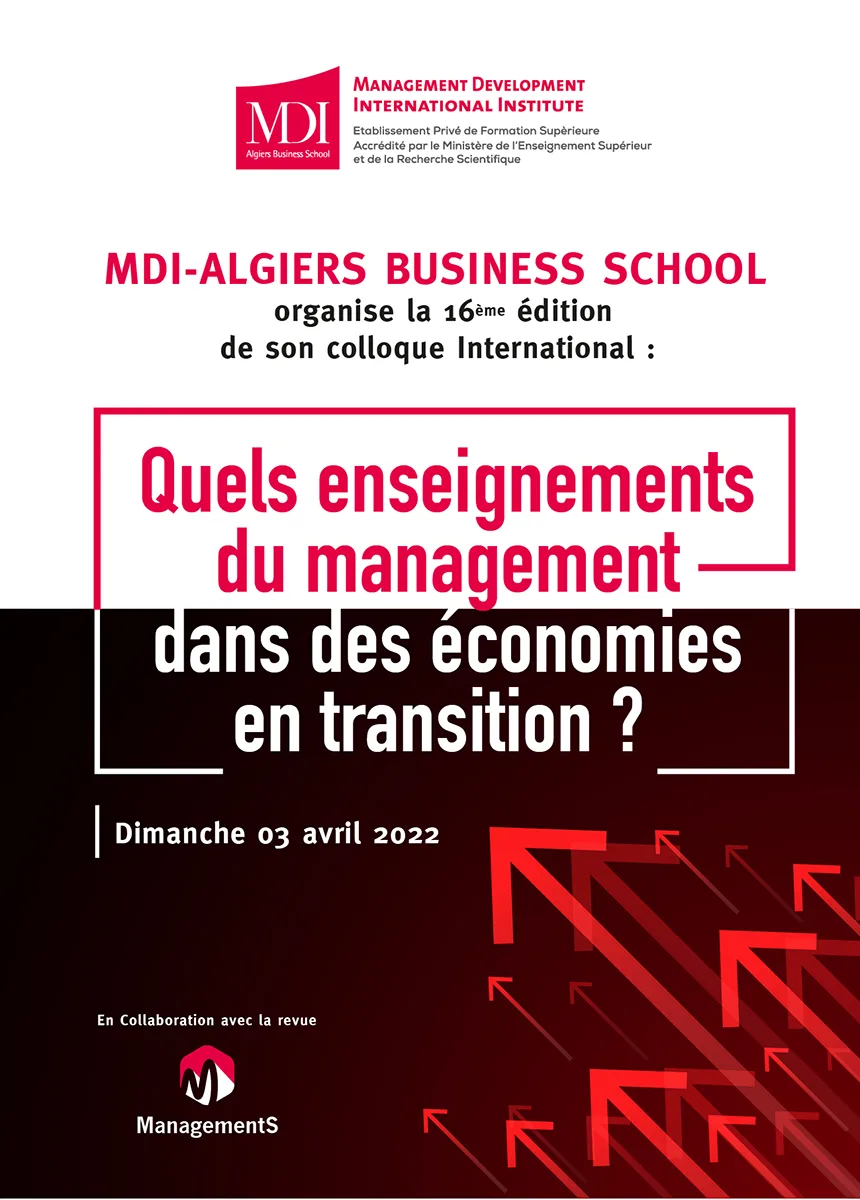
What lessons from management in transition economies?
16th international conference of MDI-Algiers Business School
In collaboration with the journal MANAGEMENTS.
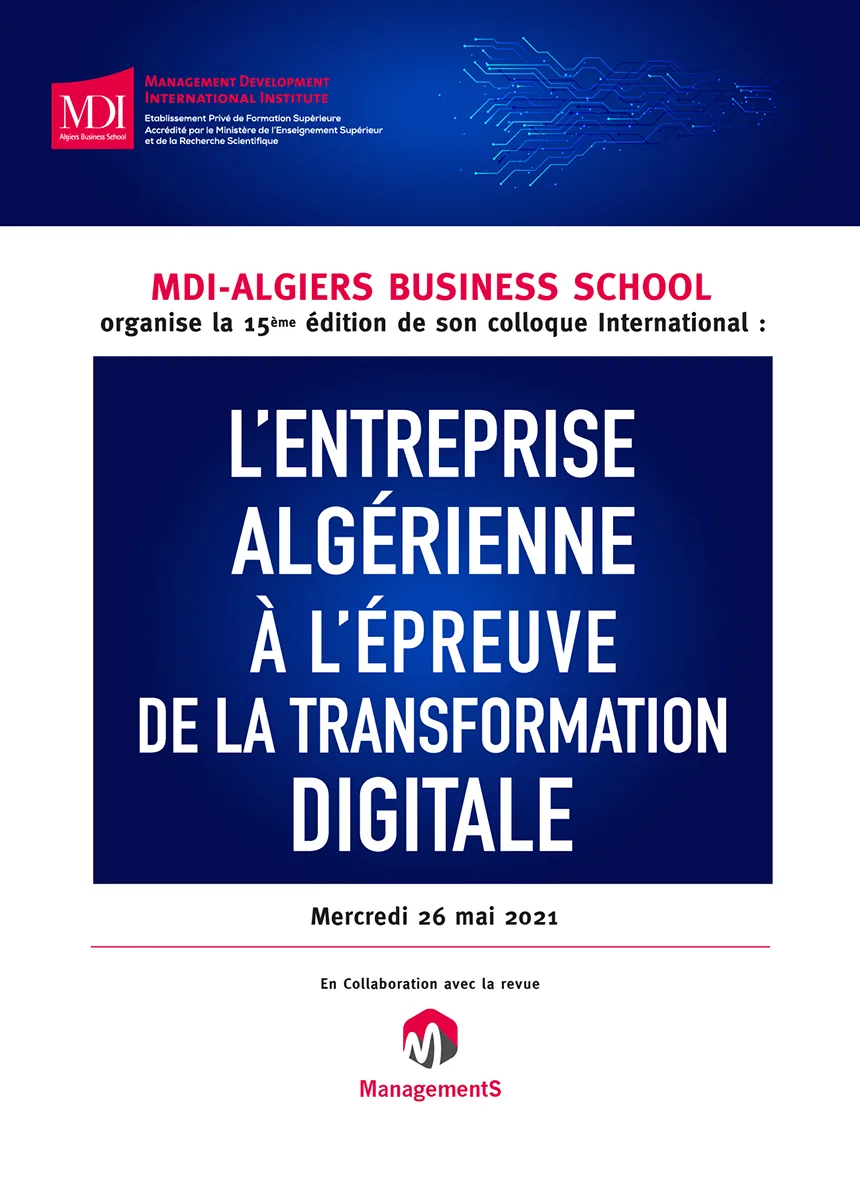
The Algerian company put to the test of digital transformation
15th international conference of MDI-Algiers Business School
In collaboration with the journal MANAGEMENTS.
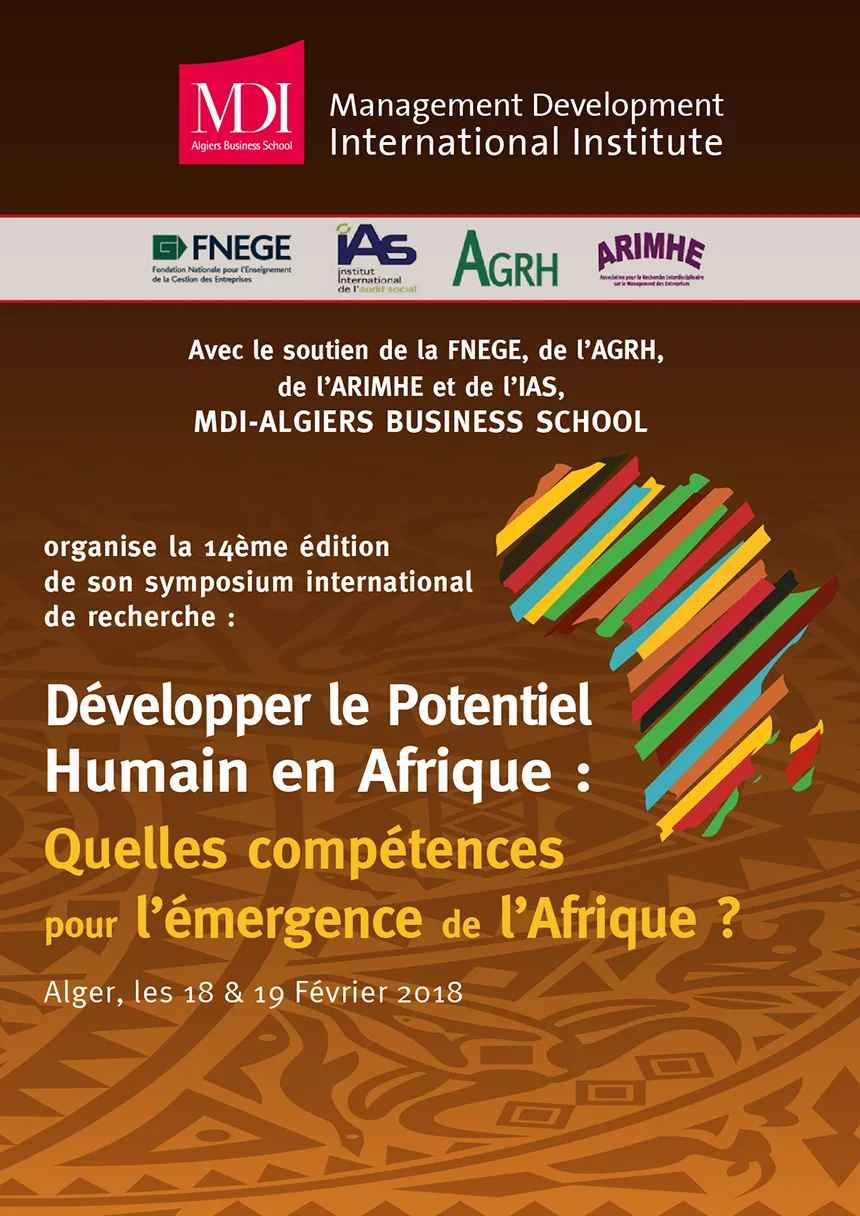
Developing human potential in Africa: what skills for Africa’s emergence?
14th international research symposium of MDI-Algiers Business School
With the support of FNEGE, AGRH, ARIMHE and IAS.
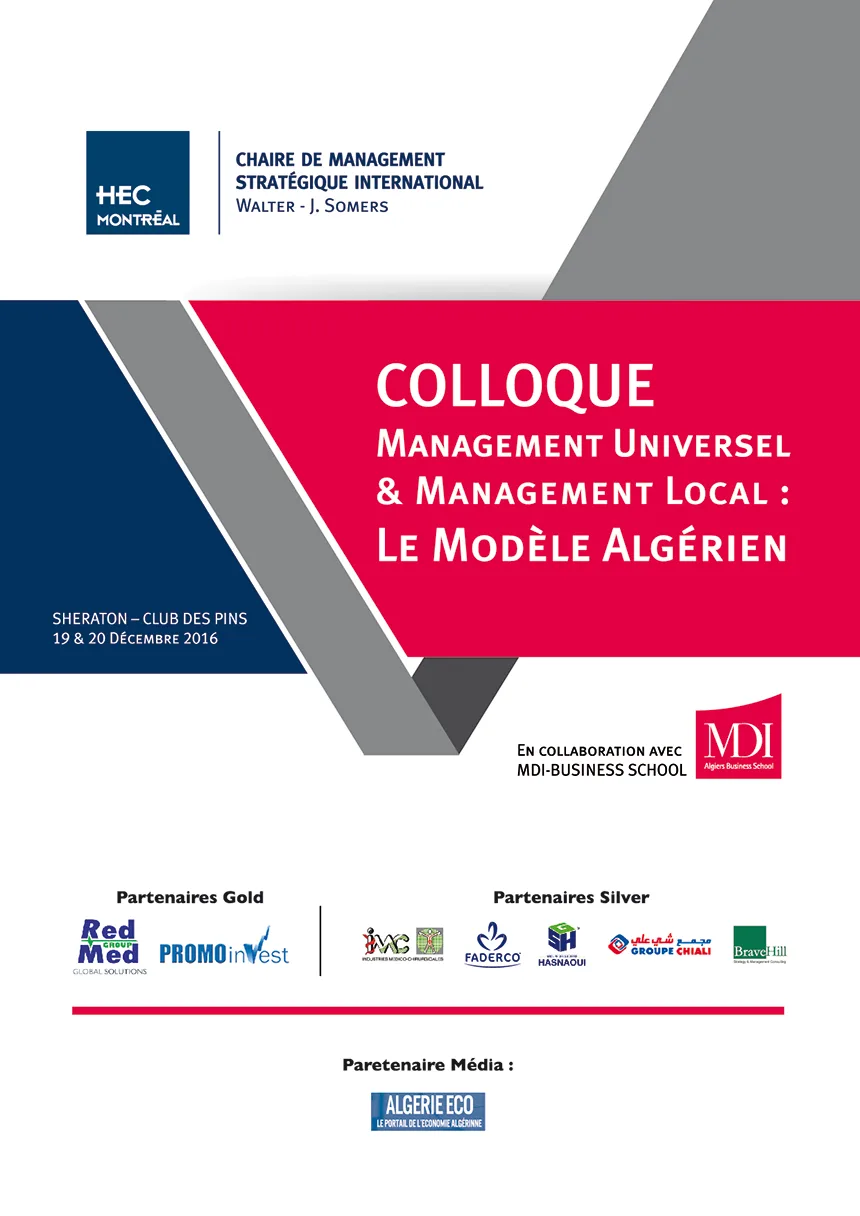
Universal management and local management: the Algerian model
Conference of the Walter-J. Somers Chair of International Strategic Management (HEC Montréal)
In collaboration with MDI-Algiers Business School.
Scientific events
Conference
3 April 2022: 16th international conference of MDI-Algiers Business School
What lessons from management in transition economies?
Scientific event
ISCID-CO international congress: sport and digital technology, well-being and employment
Longuenesse, Université du Littoral Côte d’Opale, 24 and 25 March 2022.
Scientific event
16 December 2021: workshop “Corporate governance and sustainability”
A day on the links between governance, value creation and corporate resilience.
Scientific event
4 November 2021: research workshop
The first doctoral workshop of the year, devoted to doctoral students’ research.